In this edition of POLKE POST we are delighted to share a recent research contribution on Sigmar Polke’s now iconic Höhere Wesen (Higher Beings) by presenting an excerpt from Johanna Hornauer’s newly published Postmoderne Bildparodien: Sigmar Polke und das Potential parodistischer Interventionen (Postmodern Pictorial Parodies: Sigmar Polke and the Potential of Parodic Interventions). Through a close reading of individual works from Sigmar Polke’s early oeuvre, the author explores the extent to which they challenge traditional models and patterns of interpretation through parody and thereby introduce new, sometimes surprising perspectives into existing discourses. Polke’s works, which were only created on the alleged command of “higher beings,” exemplify the complex play of norm and contradiction that is characteristic of pictorial parodies and capable of subverting the supposedly fixed interpretive sovereignties (of art) and canonical narratives. In the following extract, you will read about how the works reflect this through their various mediums and formats and how they add a political dimension to the art historical discourse:
Polke Post 22 - Johanna Hornauer about Sigmar Polke's “Higher Beings”
POLKE POST 22
Johanna Hornauer about Sigmar Polke's “Higher Beings”
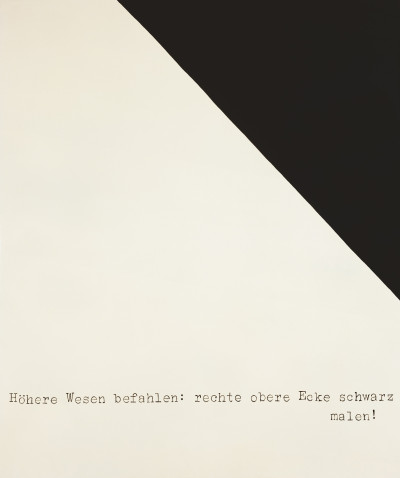
Sigmar Polke’s Höhere Wesen made him famous. There is virtually no publication about the artist that does not mention them. The best-known example of these works is a painting of the same name from 1969, in which Polke, following the wishes of his secret commissioners, painted the upper right corner of the canvas black.
Polke carries out this command in an equally laconic and witty manner, ceding responsibility for the pictorial idea to his nameless muses. Due to its simple, impersonal surface, the execution of the image is reminiscent of contemporary abstract movements and negates any artistic individualism on a formal level. At the same time, the reference to the influence of higher powers invokes the theme of the artist’s “obsession with God.” [1] This paradoxical juxtaposition raises the question: Which god could this possibly mean in the secularized twentieth century? [2] Another work by Polke provides a possible answer to this question. The first appearance of the Höhere Wesen dates to three years previously. Back in 1966, the higher beings had suggested that the artist should paint flamingos instead of a flower still life for the annual exhibition at the academy in Düsseldorf:
“I STOOD IN FRONT OF THE CANVAS AND WANTED TO PAINT A BOUQUET OF FLOWERS. THEN I RECEIVED A COMMAND FROM HIGHER BEINGS: NO BOUQUET! PAINT FLAMINGOS! AT FIRST, I WANTED TO CONTINUE PAINTING, BUT THEN I KNEW THEY WERE SERIOUS.” [3]

The flamingo painting in question is part of an installation titled Vitrinenstück (Showcase Piece). It decorates the central panel of a three-part wall display, which is reminiscent of a triptych as a result of its slightly angled arrangement. [4] To the right of the rapidly, sketchily painted birds is Polke’s confession of faith; to the left, under the heading “NOTIZEN” (NOTES), is a description of the adventurous events leading to the image’s mysterious genesis. In front of the panels is an oblong display case that completes the installation like an altar stone, containing the various exhibits or “relics” that the artist mentions in his records. They include an open catalogue from the first documenta exhibition in 1955, which is not referenced in Polke’s notes. However, it is accompanied by a commentary that contextualizes the allusions to his theoretical source of inspiration in a different way and adds an additional layer of meaning to the Vitrinenstück: “One day, they too will realize that it is better to paint on the command of higher beings.”[5] Alongside a portrait photograph of Max Beckmann, the jury members of the Künstlerbund exhibition in Cologne in 1952 are also on display; their presence lends an unexpectedly mundane air to the seemingly fantastical clash with the higher powers summoned here.[6] This is not a reference to divine inspiration, but rather the influence of official exhibition policy, which governed the West German cultural landscape of the postwar period and therefore the fates of individual artists, including Polke.[7] Yet his flamingo painting would not have impressed these authorities, nor would his initial choice of a bouquet of flowers have been shown at documenta or at the Künstlerbund exhibitions. Nevertheless, Polke’s art is presented as immune to expected criticism, since the artist distances himself from his own pictorial idea and attributes it instead to the “higher beings.”[8]
Two things can be noted from this first encounter with Polke’s supernatural commissions. First, the dialectical conflation of the affirmation and negation of familiar forms of representation and subjects (the triptych and the myths surrounding inspiration) as well as the intrinsic irony of Polke’s Vitrinenstück have already been described by researchers as a parody whose goal is to expose the normativity of art as an institution:
“But the Vitrinenstück can also be read as a parody, in the way David Roberts understands the meaning of a parody in a broader sense: namely, as an artistic modality that calls into question both the forms of production and the norms of reception that largely define the institution of art.”[9] Second, Polke’s audience learns to associate the artworks featuring the Höhere Wesen with the question of authorship, and consequently with a critique of traditional artist myths, enthusiastic moments of inspiration, and the ideological idealization of the abstract art movements of the 1950s and 1960s—and, when in doubt, to reduce them to these buzzwords. It is therefore hardly surprising that the 1968 portfolio of graphic works titled "..... Höhere Wesen befehlen" ("..... Higher Beings Ordain”) is approached with similar expectations—often without any closer attention to the form of presentation and the motifs.
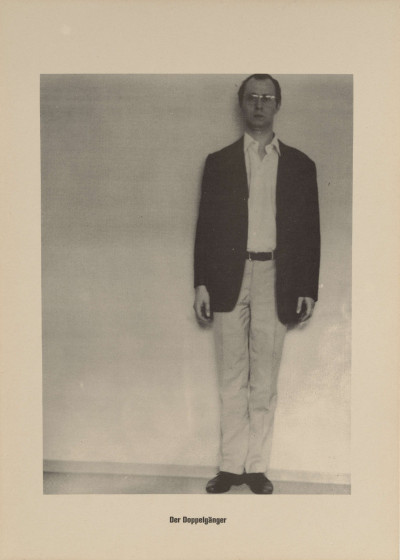
There have been no detailed studies of the prints to date. Yet even the quotation marks in the title, as indicators of irony, allude to a complex meta-structure that can be assumed to serve as a program for the prints in the portfolio and further distinguishes Polke’s parodic relationship to the West German artistic canon of the postwar years, which is inherent in his paintings and installations: the portfolio contains palms that are not palms, but in fact stacked glasses, bread or cotton structures, supernatural encounters with woolen blankets that seem to have come to life, and the artist’s supposed doppelganger. Polke presents himself here as a god-artist who guides the forces of nature, a grimacing jester who has designed a tool to align these follies—and he does this in such an ironic way that it is not he but rather the concepts he parodies that seem ludicrous and their constructed character is highlighted. With apparent ease, Polke succeeds in revealing the contrived nature of discourses about inspiration and artistic genius while simultaneously taking them to the point of absurdity.
Johanna Hornauer
[1] Martin Hentschel, “Solve et Coagula: Zum Werk Sigmar Polkes,” in Die drei Lügen der Malerei, ed. Martin Hentschel, exh. cat. Kunsthalle Bonn/Hamburger Bahnhof, Berlin (Ostfildern-Ruit, 1997), pp. 41–95, here p. 65.
[2] The terms “befehlen” (order) and “obere rechte Ecke” (upper right corner) recall the structures of unconditional obedience under National Socialism, as well as the fact that after the war a popular apology formula was that a person had only been a “Mitläufer,” a passive follower that was only obeying the orders of “higher powers.” Polke’s painting thus takes on a political dimension that opposes “uncritical obedience to the demand for ahistorical, international abstraction” and exposes this demand as an “authoritarian dictate.” See Luca Di Blasi, “Sigmar Polke: In der rechten Ecke,” Die Zeit, 15 (April 2019).
[3] Quoted from Jörg Heiser, “Im Ernst: Von polemischer Ironie zu postironischer Vernetzung in der Kunst des Rheinlands und überhaupt,” in Neues Rheinland: Die postironische Generation, ed. Markus Heinzelmann, (Berlin, 2010), pp. 13–21, here p. 13.
[4] The original flamingo image from the 1966 installation has since been removed from its former context, sold, and replaced by a similar work. However, none of the birds depicted are actually flamingos—they are herons, as indicated by their straight beaks. See Martin Hentschel, “Plotting Polke’s ‘Showcase Piece’: Irony and Parody as Vehicles of Criticism and Artistic Freedom,” in Sigmar Polke: Back to Postmodernity, ed. David Thistlewood, (Liverpool, 1996), pp. 57–70, here p. 60.
[5] Quoted from Hentschel 1997, p. 66.
[6] Those pictured are Joseph Fassbender, Karl Schmidt-Rottluff, Ewald Mataré, Thomas Hartmann, Georg Meistermann, Karl Hartung, Emil Schumacher, and Erich Heckel. See Museum Fridericianum, ed., documenta: kunst des XX. jahrhunderts; internationale ausstellung im museum fridericianum in kassel, exh. cat. Museum Fridericianum, Kassel, reprint of the original edition from 1955 (Munich, 1995), artist portrait ill. 13.
[7] Hentschel refers to the Vitrinenstück as an “allusion to the institutional mechanisms of selection.” See Hentschel 1996, p. 65.
[8] “The theoretical source of inspiration thus undergoes a double dialectic twist. On the one hand, there is an accumulation of evidence that proves the influence of ‘higher beings.’ On the other hand, this influence is downgraded to the sphere of worldly paternalism on the part of appointed art critics, and ultimately—in response to the dictates of this higher power—the artistic work becomes immune to any criticism.” Hentschel 1997, p. 67.
[9] Hentschel 1997, p. 67. Hentschel refers here to an essay by David Roberts, who analyzes the parodic staging of Peter Weiss’s play Marat/Sade, which premiered in 1964. According to Roberts, it is characterized by the fact that “the alienation of the work of art as parody is dialectical, for it involves the simultaneous negation and affirmation of the specific status of art.” See David Roberts, “Marat/Sade oder die Geburt der Postmoderne aus dem Geist der Avantgarde,” in Postmoderne: Alltag, Allegorie und Avantgarde, ed. Christa Bürger and Peter Bürger (Frankfurt am Main, 1987), pp. 47–66, here p. 176.
The above excerpt from Postmoderne Bildparodien: Sigmar Polke und das Potential parodistischer Interventionen, published by transcript in April 2023, has been edited slightly for this issue of POLKE POST.