
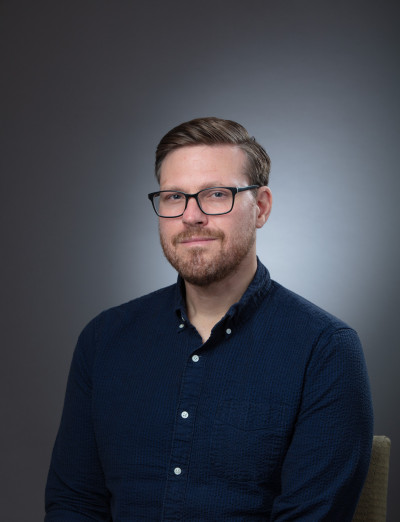
Daniel Spaulding is Assistant Professor of Modern and Contemporary Art at the University of Wisconsin-Madison. His research focuses on art in twentieth-century Western Europe, global modernism, critical theory, and the history of art history. Prof. Spaulding previously worked in the Curatorial Department of the Getty Research Institute and taught at ArtCenter College of Design in Pasadena, California. He is currently finishing a monograph on the artist Joseph Beuys, based on a dissertation completed at Yale University in 2017, as well as an edited volume on Romanticism in the visual arts. Writings of his have appeared or are forthcoming in the Journal of Art Historiography, October, Oxford Art Journal, Res: Anthropology and Aesthetics, and the Zeitschrift für Kunstgeschichte, among other publications. He is a founding editor of Selva: A Journal of the History of Art (selvajournal.org). He received the Joseph Beuys Prize for Research in 2022; in 2023, he was awarded a Wallace Fellowship from Villa I Tatti – The Harvard Center for Italian Renaissance Studies.
Scholarship 2023 - Dr. Daniel Spaulding, (Ir)rationalities of mark-making in the work of Sigmar Polke
Dr. Daniel Spaulding, (Ir)rationalities of mark-making in the work of Sigmar Polke
This project is part of a larger study of the interaction between capitalist rationalization and mimetic practices over the past century. My basic research question is extremely simple: “Is art-making a rational enterprise?” In the early twentieth century, many avant-garde practices modeled themselves on scientific research or mathematical calculation; think, for example, of the Russian Constructivists or Piet Mondrian’s Neoplasticism. Sigmar Polke would appear to mercilessly ironize these rationalist pretentions in well-known works such as Moderne Kunst (1968). Yet at the same time, Polke’s art in the 1960s and ’70s was deeply engaged with modern techniques of mechanical reproduction, such as halftone dot printing, even as his approach to manual gesture undermined the intuitive expressionism of the preceding modernist generation. In the research that this grant will support, I intend to investigate this dialectic in Polke's art by focusing on the two forms that I call the raster and the squiggle. The raster is a mimesis of automatized image-making, whereas the squiggle is a mimesis of “free” gestural expression. What is important is, first, that neither is exactly identical with the kind of mark-making that it imitates, and second, that neither exists in isolation from the other; rather, technical reproduction mediates irrational impulses even as quasi-Dadaist absurdities undermine technical rationality. The outcome of my research will be a chapter in a book in which I will focus on three moments in the relation between art and modern technical/economic rationalization: namely, 1) discourses of mimesis and construction in the 1920s; 2) interactions between art, labor, and capitalist production in the Federal Republic of Germany in the 1960s-70s; and 3) the curious simultaneity of a vogue for new animisms in the art world (“the agency of things”; “vibrant materiality”) with the rise of artificial intelligence technology, and in particular new generative imaging algorithms, in the early 21st century.