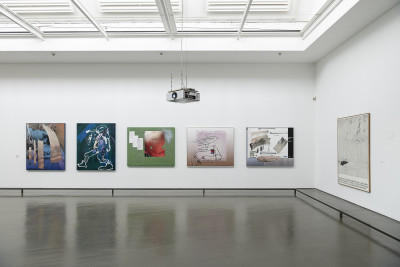
A year ago, we opened the exhibition Productive Image Interference. Sigmar Polke and Artistic Perspectives Today at the Kunsthalle Düsseldorf.
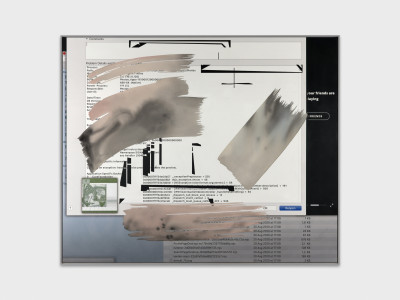
For the exhibition the artist Camille Henrot created a new group of works, Dos and Don'ts, in collaboration with Mike Karstens.
In conversation with curator Nelly Gawellek, she talks about the production of the works, her artistic affinity with Sigmar Polke, and the technical possibilities of the present.
Nelly Gawellek: Hello, Camille. We invited you to be part of the exhibition Productive Image Interference, and in our first Skype call—I think it was in June 2020—you told me that Sigmar Polke has had a great influence on you. What was it in his works that fascinated you?
Camille Henrot: What was really encouraging for me was his relationship to style and images and especially his acceptance of inconsistency in terms of style. He uses images like an alphabet, a sort of code. Another thing that attracted me is his interest in tricks and imitation—he would imitate a technique that is easy to reproduce technically but a lot of work to “fake.” It’s a subtle shift of aesthetics that allows the image to be understood in a completely different way. I’m thinking of his Rasterbilder [pictures based on the halftone printing technique], where he imitates printed images, but the work is done by hand.
For my own works I thought about how some printing techniques appear to imitate the hand and how much the hand is then, in return, trying to imitate the print. It is a rather perverse circle in terms of image making, and that idea was interesting to me. This is why I proposed to create new works for the exhibition. Drawing is my main activity, but when we started talking, I had started painting only a year prior. I had been interested in the idea of creating paintings that don’t look like they are painted or play with the possibilities that new printing machines or computer applications like Procreate or Photoshop offer. They have tools that imitate painterly techniques while having their very own aesthetic that has almost become a tradition in painting itself through the work of other artists such as Avery Singer.
“Image interference” means two different things to me: the interference of new technologies into image making, but also the potential of images in regard to their role in our society. I have been asking myself how images are coded today and how existing images can be used like an alphabet. I like Roland Barthes’s idea that language is fascist, but literature is freeing.
I think it’s similar in image technology. There is something fascist about the internet, with Google, for example. There is so much information, but it’s directed and controlled. Yet in the process of reappropriating those images, there is a way to recreate a freedom and a space of challenging main discourses.