Our online festival, part of the anniversary project Productive Image Interference, is now open to visitors!
Contributions by such international artists and scholars as Bice Curiger, Raphael Hefti, and Alexander Kluge develop new perspectives on Polke’s oeuvre, sometimes in direct dialogue with contemporary work. We hope that you enjoy watching and encountering some stimulating insights into the subject of Productive Image Interference: Sigmar Polke and Artistic Perspectives Today.
In addition to the central subject of Productive Image Interference, other matters have also become evident, including questions around authorship, as demonstrated in various ways by both the works of art and academic debate. It is just such aspects that we would like to explore in the current issue of POLKE POST.
Polke Post 15 - Dana Bergmann on authorship in the exhibition Productive Image Interference
POLKE POST 15
Dana Bergmann on authorship in the exhibition Productive Image Interference
The question of what exactly defines an artist is, even today, subject to constant revision. At least since the debates around the 'death of the author,' introduced by Roland Barthes’ 1968 text of the same name, as well as Michel Foucault’s What is an Author? from 1969, notions of the author or artist as a subject acting autonomously have been questioned. The historical or romantic, but at the same time outmoded, idea of the artist as genius and creator (or craftsperson) has changed fundamentally today, not least in the digital age, and as a result such fundamental art world premises as authorship, the fetishizing of art, originality, and the conditions of production are being questioned and recontextualized. It is therefore completely normal today for artists to utilize the existing (digital) inventory of imagery, returning to all the material that is available, appropriating and editing it. From the early 1960s, Sigmar Polke had been interested in the imagery of his time [1] that was being disseminated by the mass media, and a wide range of materials found their way into his work. Imagery and texts from the most diverse areas of life served as sources for his art. He found his materials in newspapers, magazines and historical documents, in children’s, travel, and fairy tale literature, in comics, cookery books, old school notebooks, and advertising leaflets.[2]
Such working methods have found their way into art history as Appropriation (Art). From Georges Braque’s collages from the beginning of the 20th century, to 1960s Pop Art, and the so-called Pictures Generation (the first generation of artists in the 1970s, who grew up with such media as film, photography, and mass-circulation imagery from magazines), all made existing imagery the point of departure for art. [3] Among the early and probably best-known examples of Appropriation Art are Marcel Duchamp’s readymades. Duchamp appropriated existing 'material', removing everyday objects from their original context and relocating them in the one of art. The concept of appropriation was only later, during the 1980s, subsumed under the label Appropriation Art in artistic practices that were primarily based in New York.[4] Appropriation Art involves the direct copying of an already existent work of art or the use of pre-existing materials, commandeering the source for the artist’s own work. Everything is apparently available to the appropriation artist – the entire inventory of visual culture.[5]
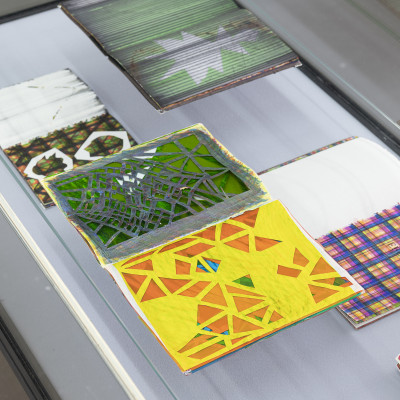
Kerstin Brätsch also seizes upon the fundamental ideas of Appropriation Art in her work, questioning in a double sense her own authorship. Without directly copying the works of other artists, her working method could nevertheless be understood as a kind of continuation or further development of appropriation, in which references to art-historical models or predecessors are made conspicuous. Brätsch, like Polke, incorporates such traditional craftwork practices as glass painting, but also employs agate discs in some of her works, which Polke had likewise utilized in his church windows for the Grossmünster Zürich. [6]
At the same time, the artist raises questions about the distinction between art and craft, while working collaboratively and across differing media. The sensitive, colored drawings that can be found in her lined notebooks (since 2000) serve as a source, the designs and imagery being transcribed into the medium of glass. Brätsch becomes a producer of ideas as well as a commissioner of works which are executed by trained glass painters. In those instances, where Brätsch or Polke refer to art-historical predecessors – whether in the use of already existing imagery or in a similar handling of materials – a critical examination of their own handwriting, [7] or authorship, and the situating of their own practices in art history become explicit.
In her work, the artist Camille Henrot questions her own creative practice together with the conventions involved in the production of paintings. In an interview with Nelly Gawellek for the festival, she describes her fascination with the kind of painting that is not supposed to look like painting, as well as computer programs that attempt to imitate it. She draws attention to the nature of imagery, reflecting on the conceptual and habitual features of traditional imagery and the traditional production of art. She not only combines such diverse media as painting, digital collage, and a range of printing techniques, but also includes found (image) sources from a variety of contexts, combining them with her own artistic interventions, painterly gestures, and personal imagery.[8] Since Henrot’s works are not pure copies of existing imagery, the aspect of appropriation can be better understood as a permeating or internalizing, resulting in the source material being shaped, composed, and edited anew.[9] Here the relationship between work being referenced and appropriation is displayed as an active and distinctive dialogue between the artist, the original, and a new piece of work.[10]
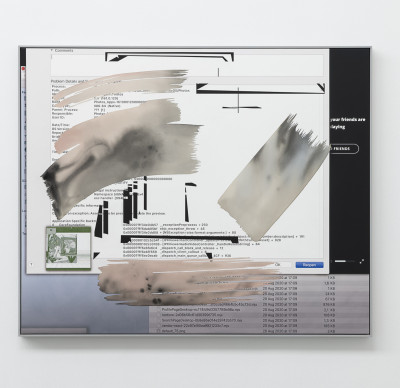
Various strategies of appropriation can also be applied to the production of contemporary art, in terms of its networking of content and the blurring of authorship that have accompanied digitization. [11] New forms of art practice become recognizable, enabling such phenomena as shared or collective authorship, anonymity, an acknowledgement of automated (technological) operations, computer-generated processes, errors, interference, and accidents to emerge.
In his works, Seth Price likewise addresses questions concerning originals and copies as well as such issues as copyright and the circulation of imagery on the internet. Appropriation, reproduction, and dissemination of imagery and media from a range of areas are essential aspects of his work. In her paper for the festival, Sandra Neugärtner illustrates the artist’s working methods that were also employed in his video work Redistribution (since 2007), which exists in various versions. Price continually commandeers information from the web, feeding it back into the internet and consequently into the circuits of art production. There remains something unstable about the medium for him, since everything can be replaced or changed at any time. Nothing is ever finished or final. Process is directly connected to and an integral part of the work, which makes no attempt to reach any conclusion, but remains as distributive as the title of the work suggests, that is an ongoing dissemination, with the original producers of the images no longer remaining visible in the role of author.
Other aspects of authorship, in which artists to an extent withdraw, permitting the materials used to prevail, is demonstrated not only by some of Polke’s photographs but also the photograms by Raphael Hefti, which are discussed in the panel Materialproben (Material Samples). In Polke’s contribution to the art magazine Parkett Desastres and other Sheer Miracles I (1984) the medium of photography was tested as seldom before. From an old negative film, which he had previously developed, with the assistance of Pril detergent, raspberry schnapps, and coffee, he made enlarged prints, interfering in the process yet again by using other chemicals and, to a certain extent, abandoning control of the production of the imagery. [12] While Bice Curiger discusses the background to the genesis of the leporello in her paper for the festival, in the Material Samples panel Franziska Kunze aptly illustrates how the chemicals in Polke’s group of works Desastres and other Sheer Miracles (1982/84) increasingly act autonomously, operating in a manner that enables the materials to tell their own story. The process of an image’s emergence alternates between control and a loss of it.
The Swiss artist Raphael Hefti likewise focuses on process in creating his works as well as the particular properties of the materials involved. He describes the creation of the Lycopodium series (2012–2015) as a controlled accident where experiment and performance meet, with the artist purposefully manipulating the photographic paper to steer the traces left by the burning moss in the 'right' direction, in order to approach the type of imagery he is seeking. In employing materials and processes in a manner deviating from their original purpose, Hefti not only questions the artistic process but permits chemical reactions or uncontrollable production processes to demonstrate their aptitude in creating imagery.[13] The question ultimately arises as to who the actual author is when all three factors are involved in the working process: the medium itself, the materials employed, or the artist?
The works of the artists on display and discussed during the festival concern appropriation less in the sense of copies of existing works of art, but rather in the use, processing, and reinterpretation of materials and imagery, the probing of the possibilities presented by technology, experimentation, the testing of boundaries and media-specific principles, as well as the questioning of practices that are frequently inter- or multidisciplinary, in which new contexts for meaning are developed and made available in terms of the artist’s own work and the questioning of their authorship. In our everyday life we are surrounded by imagery in various print media, in advertisements, on digital screens, and in virtual windows. Imagery can influence, inspire, or disturb and is subject to constant change, whereby it is renegotiated, repositioned, and recontextualized, becoming part of the recipient’s own perspective and enabling new (types of) motifs and visual worlds to emerge.
Dana Bergmann
[1] Kathrin Barutzki and Nelly Gawellek, “Productive Image Interference: Sigmar Polke and Artistic Perspectives Today” in: Productive Image Interference: Sigmar Polke and Artistic Perspectives Today,
exhib. cat. Kunsthalle Düsseldorf 2021-2022, Berlin 2021, pp. 53-60, here p. 53.
[2] Ibid., p. 56.
[3] https://www.monopol-magazin.de/metro-pictures-gallery [last accessed March 18, 2022].
[4] Isabelle Graw, “Dedication Replacing Appropriation,” in: Remastered. The Art of Appropriation,
exhib. cat. Kunsthalle Krems 2017-2018, Cologne 2017, pp. 77-92, here p. 84.
[5] Ibid.
[6] Charlotte Lang, in: Productive Image Interference: Sigmar Polke and Artistic Perspectives Today, exhib. cat. Kunsthalle Düsseldorf 2021-2022, Berlin 2021, p. 63f.
[7] Kathrin Barutzki and Nelly Gawellek, “Productive Image Interference,” in: Productive Image Interference: Sigmar Polke and Artistic Perspectives Today, exhib. cat. Kunsthalle Düsseldorf 2021-2022, Berlin 2021, pp. 53-60, here p. 57.
[8] Ibid., p. 53.
[9] Ibid., p. 16.
[10] Verena Gamper, “Appropriation as Dialogue: Artworks Among Themselves,” in: Remastered. The Art of Appropriation, exhib. cat. Kunsthalle Krems 2017-2018, Cologne 2017, pp. 13-23, here p. 16.
[11] Naoko Kaltschmidt “Elective Affinities,” in: Remastered. The Art of Appropriation, exhib. cat. Kunsthalle Krems 2017-2018, Cologne 2017, pp. 163-173, here p. 168.
[12] Ibid., p. 59.
[13] Ibid.