POLKE POST 31
Invitation POLKE SALON: Wir Kleinbürger! Zeitgenossen und Zeitgenossinnen (We Petty Bourgeois! Comrades and Contemporaries)
We cordially invite you to the POLKE SALON 13: Wir Kleinbürger! Zeitgenossen und Zeitgenossinnen (We Petty Bourgeois! Comrades and Contemporaries)
Petra Lange-Berndt (Professor for Art History, University of Hamburg) in conversation with Astrid Heibach (Artist and filmmaker, Coogne) about Sigmar Polke's intermedial and audiovisual exhibition practice in Bern (Galerie Toni Gerber, 1976/77) and in Hamburg (Hamburger Kunsthalle, 2009/10)
Thursday, October 30, 2025, 7pm
Anna Polke-Stiftung
Domstraße 60, 50668 Cologne
Petra Lange-Berndt, together with Dietmar Rübel and Dorothee Böhm, curated the exhibition Sigmar Polke: We Petty Bourgeois! Comrades and Contemporaries. The 1970s at the Hamburger Kunsthalle in 2009/10, which shed light on Polke’s previously less-noticed work from the 1970s and the processes behind its creation. Astrid Heibach participated as an artist in various exhibitions of the 1970s and, for the exhibition at the Hamburger Kunsthalle, collaborated with Sigmar Polke on his 16mm films.
As a preview of the conversation, here is an excerpt from a text by Petra Lange-Berndt & Dietmar Rübel on Sigmar Polke’s eponymous body of work:
[...] With its shrill aesthetics, We Petty Bourgeois could be described as painterly feedback on a world conveyed by mass media. By the 1960s Polke had already begun using media technologies such as an episcope and slide projectors to transfer popular motifs onto painting by hand. Analyzing the torrents of mass media, the artist famously made the Benday dots of printed matter his trademark and used them to address the structure of single images, "the molecular field" comprised of the smallest viible element [7]. "Point for point, things are revised here," as Benjamin Buchloh put it.[8]
Excerpt from :
Petra Lange-Berndt & Dietmar Rübel: „Multiple Maniacs! Lines of Flight in Sigmar Polke & Co.“, in: Lange-Berndt & Rübel (ed.): Sigmar Polke: We Petty Bourgeois! Comrades and Contemporaries. The 1970s, Cologne, Walther König, 2011, p.28–89, here p.30–34.
[7] See Benjamin H.D. Buchloh, "Parody and Appropriation in Francis Picabia, Pop and Sigmar Polke," Artforum 7 (March 1982): 28–34, esp. 33.
[8] See Benjamin H.D. Buchloh, "Polke und das Große Triviale (mythisch oder pythisch?)," in Sigmar Polke: Bilder, Tücher, Objekte: Werkauswahl, 1962–71, exh. cat. (Tübingen: Kunsthalle Tübingen 1976), 135–50, esp. 142.
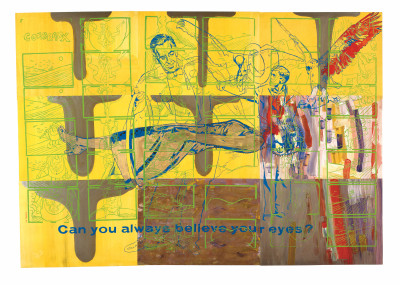
[9] The levitating woman in Can You Always Believe Your Eyes? and the snake that consitutes the ornament of the masses in Human Snake are both painted with phosphorescent materials. For a short history of these "crazy colors" see Esther Leslie, Synthetic Worlds: Nature, Art and the Chemical Industry (London: Reaktion Books, 2005), 233ff.
[10] According to the installation shots these were Human Snake, Snakeskin (1974), a gouache that used to be part of the Petty Bourgeois cycle, and an early stage of Pill. For the exhibition Hallo Shiva at the Gallery Klein see Dieter Buchholz: "Irgendwo zwischen Pop und Concept. Kunstmuseum und Galerie Klein zeigen Arbeiten von Sigmar Polke," General-Anzeiger Bonn (27 April 1974), 23.
[11] This condition was partly lost during conservation processes in 1999.
[13] Evelyn Weiss, "Versuch eines Vorworts," in Sigmar Polke, Achim Duchow, Astrid Heibach and Katharina Steffen, Day by Day... They Take Some Brain Away (Cologne and São Paulo: n.p., 1975) unpaginated; reprinted in this volume, 327–54, esp. 328.
[14] Martin Hentschel has described this juxta- and superimposition in his study "Order of the heterogenous" (Die Ordnung des Heterogenen: Sigmar Polkes Werk bis 1986, PhD diss, Univ. Bochum, 1991).