
On February 13, 2022 we will be celebrating what would have been Sigmar Polke’s 81st birthday and are delighted that the exhibition Productive Image Interference: Sigmar Polke and Artistic Perspectives Today that we organized for the 80th anniversary, has been extended until March 6, 2022. We would like to thank not only Kunsthalle Düsseldorf, but also the participating artists and lenders to the exhibition for making this possible.
The festival at Kunstakademie Düsseldorf (November 25-27, 2021), planned to accompany the exhibition, had to unfortunately be canceled as an in-person event, but all contributions will be published on the website.
In the meantime, we are pleased that there has been a great deal of public interest in the exhibition and that we have been able to hold a number of other planned events on site and in front of the works. On January 20, 2022 the artist and author Hans-Christian Dany talked to Max Schulze about the “desire to disappear.” Last weekend, in what had actually been planned as a finissage event, we were able to welcome Kerstin Brätsch and Urs Rickenbach, who spoke with curator Patrizia Dander about the processes involved in creating Brätsch’s glass paintings, as well as Polke as an artistic paragon and his major cycle of church windows in Zürich’s Grossmünster. For March 6, 2022, now the final day of the exhibition, we are still working on a program of events – which will include birthday cakes and music if Corona restrictions allow.
Polke Post 14 - Happy Birthday – again, Sigmar Polke!
POLKE POST 14
Happy Birthday – again, Sigmar Polke!
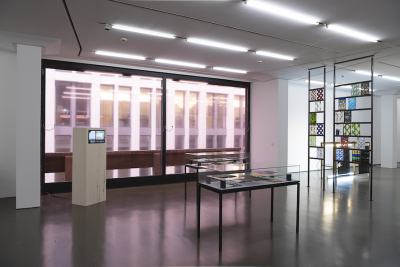
Since 2011 Kerstin Brätsch has been working with Urs Rickenbach and the Mäder glass workshop in Zürich, where the Polke windows were also fabricated. For the Productive Image Interference exhibition she has created an installation from both existing and new works in glass (Die Namen/Die Linien, 2021). In her exploration of glass as a material and the working processes it involves, which has been ongoing now for more than a decade, and carried out in collaboration with the craftspeople at Glas Mäder, Brätsch tests not only the limits of artistic autonomy but also those of traditional genres.
For the exhibition catalogue, Charlotte Lang explored the manner in which such visual or, in this case, art historical disruption, or interference, has occurred in the work of both Kerstin Brätsch and Sigmar Polke.
On the occasion of Sigmar’s 81st birthday, we would like to share with you this encounter between work, Sigmar Polke – Kerstin Brätsch. For us, the juxtaposition provides an outstanding example of how Polke’s works continue to have an impact on the present, as a source of inspiration for current artistic practices and as a point of departure for discussions concerning issues around art that remain extremely relevant today.
For the exhibition catalogue, Charlotte Lang explored the manner in which such visual or, in this case, art historical disruption, or interference, has occurred in the work of both Kerstin Brätsch and Sigmar Polke.
On the occasion of Sigmar’s 81st birthday, we would like to share with you this encounter between work, Sigmar Polke – Kerstin Brätsch. For us, the juxtaposition provides an outstanding example of how Polke’s works continue to have an impact on the present, as a source of inspiration for current artistic practices and as a point of departure for discussions concerning issues around art that remain extremely relevant today.

“All Ready Maid—as the title of Kerstin Brätsch’s series of works suggests, everything in art would appear to already have been done. Consequently, every artistic practice is inevitably part of a multitude of traditions. Any artist’s critical examination of their own work will also entail a confrontation with the höhere Wesen (higher beings) of (art) history.
Sigmar Polke demonstrated what form such an undertaking could take by conceiving a symbiotic model, with none other than Leonardo da Vinci, for the catalogue Konzeption—Conception, published in 1969 for the eponymous group exhibition at Museum Morsbroich, Leverkusen. Konstruktionen um Leonardo da Vinci und Sigmar Polke (Constructions around Leonardo da Vinci and Sigmar Polke) was engendered by Polke’s desire, at the early age of twenty-eight, to identify his own most important biographical data. To this end, the artist transposed information relating to his life and work onto a less well-known part of Leonardo’s biography: self-magnetization, the Sforza monument, photographs from the palm series, work on the Last Supper—all of it arising from a shared energy! The inventory is accompanied by a meticulous drawing on graph paper that illustrates key biographical details and their method of identification with the assistance of the Golden Section. Polke inscribed himself within the vita of the great Italian artistic genius, openly and humorously asserting his own entitlement to a position worthy of him within the canon of art.
For Kerstin Brätsch, whose artistic methodology represents something of an ongoing stress test in terms of discourses on painting, Sigmar Polke belongs to a previous generation’s notions of artistic persona whose legacy fuels a self-reflective practice such as her own.
Polke’s and Brätsch’s career paths intersect at the Mäder glass company in Zürich. Polke worked there from 2006 to 2009 with the glass painter Urs Rickenbach in fabricating church windows for the Grossmünster in Zürich. A few years later Brätsch experimented with transferring her painting to the medium of glass with Rickenbach’s help. From 2012 onwards, her group of “antique glass” pieces from the series All Ready Maid Betwixt and Between such as Holo Mai Pele, Is It You or Perhaps You? (Mund der Wahrheit) (Holo Mai Pele, Is It You or Perhaps You? [Mouth of Truth]) and Holo Mai Poli‘ahu: Facefold (dritte Dame) (Holo Mai Poli‘ahu: Facefold [Third Lady]) were produced. For these works, the artist not only used luster, enamel, lead, and black solder on antique glass, but also incorporated glass jewels, church-window bordering, and agates slices, which Sigmar Polke had similarly employed in his church windows. The results are grimace-like glass portraits that acquire a peculiar corporeality despite the transparency and fragility of the medium. In particular, the psychedelically wide-opened eyes, created using agate slices, seek direct contact with the viewer through their imitation of irises. In addition to a swipe at the father figure of Marcel Duchamp, Sigis Erbe (Sigi’s Legacy) is also part of Brätsch’s works, in which such artist’s artists are inevitably evoked. By working through artistic predecessors in such an unabashed and self-deprecating manner, a fundamental relationship between Brätsch and Polke’s practices emerges. Both evoke the höhere Wesen (higher beings), inviting them to actively participate in their artistic discourses.”
Charlotte Lang, Sigmar Polke – Kerstin Brätsch, in: Productive Image Interference. Sigmar Polke und Artistic Perspectives Today (Kunsthalle Düsseldorf, Berlin, 2021), pp. 62–65