
In the current issue of POLKE POST, we would like to combine a report from our archive with a thank you for a donation that makes a valuable contribution to the scholarly investigation of Sigmar Polke's work. We express our heartfelt thanks to Prof. Henry von Bose DD, who donated to us a copy of the wedding newspaper printed for the marriage of his grandmother Lotte to Waldemar von Böttinger on 12 October 1911. The title page of the newspaper, which is designed in the style of the daily B.Z. am Mittag (Berliner Zeitung am Mittag), published until 1943, is the basis for an early raster-dot painting by Sigmar Polke from the mid 1960s. This piece, entitled B.Z. am Mittag (1965), is kept in the collection of the Museum Abteiberg in Mönchengladbach.
Polke Post 4 - B.Z. am Mittag – a donation to our archive
POLKE POST 4
B.Z. am Mittag

It is known that Sigmar Polke was commissioned in 1965 to create a gift for Lotte von Böttinger's 75th birthday. Prof. Henry von Bose DD has now explained to us in more detail the family background to the original picture and also to the history of the commission. The starting point for this commissioned work can be found in the exhibition Neue Realisten, in which Rudolf Jährling showed works by Gerhard Richter, Konrad Lueg and Sigmar Polke in his gallery Parnass in Moltkestraße 67 in Wuppertal-Elberfeld from 20 November to 30 December 1964 [1].
“I myself was 20 years old at the time and have this situation clearly before my eyes. There was a lot of talk about the exhibition in our family living in Elberfeld and among relatives.”
The exhibition particularly attracted the interest of art collectors from the surrounding area. As a result, Gerhard Richter subsequently received various commissions to make portraits by the Rhineland entrepreneur Willy Schniewind and his wife Fänn [2]. The intermediary was Rudolf Jährling, among others. Lotte von Böttinger was also born a Schniewind and Willy Schniewind was her cousin. Indeed, it was the couple Willy and Fänn Schniewind who commissioned Polke to execute the painting B.Z. am Mittag. Henry von Bose explains:
“The story of Sigmar Polke's work BZ am Mittag from1965 began with the couple Willy and Fänn Schniewind, who were close friends with my grandmother Lotte von Böttinger. They were looking for a suitable present for Lotte's 75th birthday on 23 November 1965. Just in time, a copy of the wedding newspaper for the young couple Waldemar and Lotte von Böttinger, my maternal grandparents, of 12 October 1911 was found: Boettinger - Zeitung am Mittag with the headline ‘Der Sohn des Farbenkönigs heiratet die Seidenprinzessin’ (The Son of the Paint King Marries the Silk Princess). The newspaper was based on the layout of the Berlin newspaper
B.Z. am Mittag. I don't know how and through whose mediation the title page of the ‘Illustrated Supplement’ of this wedding newspaper made its way from the clients to the artist. It can be assumed that there is a parallel to Richter's commission to make portraits of the married couple Willy and Fänn Schniewind. In that event Rudolf Jährling would have commissioned the work.”
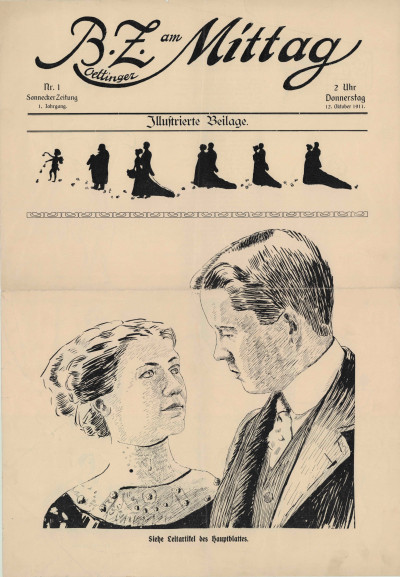
The design of the wedding newspaper in the style of the Berlin daily is related to Waldemar’s family history. His father, Privy Council Dr. h.c. Henry Th. von Böttinger, was closely connected with the city of Berlin, both as a professional and as a volunteer, and members of the family often stayed in the city. The permanent residence of the von Böttinger family in Haus Sonneck in Wuppertal-Sonnborn was also taken up: in the title, the newspaper is presented as an Illustrierte Beilage (illustrated supplement) to the first issue of the SonneckerZeitung (instead of the Berliner Zeitung).The back mainly consists of jokes made at the expense of the young bridal couple in the form of an illustrated poem and humorous commentaries.
Polke's B.Z. am Mittag plays a special role within the group of raster dot works: it is one of the early works in which the artist had already altered his original painterly strategy of transferring mass-reproducible advertising images to canvas. While the raster dot works initially referred to an actual printing product, he subsequently repeatedly created freely invented raster dot works or at least changed the motif. The same goes for the birthday piece created for Lotte von Böttinger. Polke's painting mimics being a mechanical reproduction of a printed product, but in reality is not a repetition at all. The rasterization of a picture comes to light when it is blown up and one of the essential characteristics of raster dot works lies in the enlargement of their details. Viewers do not see enlarged details more clearly. On the contrary, the dots blur the picture, the contours dissolve, and the reproduction reveals the artificial construction of the image. Martin Hentschel emphasized the phantasmagorical qualities of this mechanism and rightly stressed that the original template – B.Z. am Mittag printed in 1911 – had already been a "simulacrum" because the wedding newspaper merely pretended to be a newspaper.
"The result is highly ornamental. The remarkable thing, however, is that Polke develops the whole picture from a raster for which a template never existed. In addition, it covers the entire picture area, while the title page itself performs only limited representational functions. The raster thus does not imitate a newspaper grid; rather, it appears to be an abbreviation of the imaginary image of the 'newspaper'. In relation to the motif, the raster metamorphoses into the medium of imaginary memory.” [3]
In the 1960s, Sigmar Polke used a manual raster-dot technique, but also deployed stencil and spray paint and painted or stamped individual dots (with an eraser). For B.Z. am Mittag, Polke first rastered the entire surface of the canvas and then worked out the forms of the motif by connecting the dots with the brush. The merging of the raster dots yields the motif, which is not reproduced true to detail and has an irregular structure. The text that was not transferred in its entirety also breaks with the system. The two faces of bride and groom in Polke's interpretation consist only of coarse physiognomic features. The individuality and subtleties that find expression in the wedding newspaper, particularly in the varying fine hatchings of the monochrome printing technique, no longer play a role with Polke.
"Sigmar Polke's raster painting hung for years in the entrance of the house my grandmother had built in 1965/66 in Wuppertal-Elberfeld. (...) Only after the death of the donor of the work did she take it down. (...) After fifteen years, the picture they gave her found a not exactly prominent place in a guest room in the basement of my grandmother's house, which sometimes resembled a storeroom. Once I went in there and saw a manual lawnmower leaning against it.”
In 1966, the artist had stressed that he liked the "cliché character of the screen"," the impersonal, the neutral and the fabricated". [4] And indeed, the disintegration and dissolution of an image into dots that move and unfold their own dynamics leaves little room for liveliness or individuality. A wedding newspaper, however, is a personal and emotional document of one's own life story. Perhaps Lotte von Böttinger, who, according to her grandson, preferred turn-of-the-century and Impressionist art anyway, had reservations about this birthday present because of this; as the starting point for a raster dot work, however, it may have been an attractive motif for the artist precisely for this reason.
Sophia Stang
[1] See Günter Herzog: “Ganz am Anfang”, in sediment - Mitteilungen zur Geschichte des Kunsthandels, ZADIK, 7, 2004
[2] Cf. Richter WVZ 42, 42-1, 42-2.
[3] Martin Hentschel: “Solve et Coagula. Zum Werk Sigmar Polkes“, in Sigmar Polke. Die drei Lügen der Malerei, exh. cat. Bonn, Kunst- und Ausstellungshalle/Berlin, Nationalgalerie im Hamburger Bahnhof. Ostfildern 1997, pp. 41-91, here p. 55f.
[4]Sigmar Polke: “Kultur des Rasters. Ateliergespräch mit dem Maler Sigmar Polke“, in Rheinische Post, No. 108, 10 May 1966.
Translation: creativ Übersetzungen / Sebastian Viebahn, Köln