This was Sigmar Polke’s melancholic and ironic response to a question as to why he used images from newspapers and magazines as a pictorial model for his work in the 1960s. His remarks suggest that the practice of drawing has become ‘unfree’, something deracinated and subjected to administrative control. Drawing, for Polke, can no longer be something that calls forth an authentic sense of subjective wholeness or corporeality. It can only now be lacking, or ‘bad’, according to these criteria. Instead, it functions according to what Benjamin H.D. Buchloh has, in another context, called a "diagrammatic paradigm", which records an image of alienation from our own bodies.[2] Polke made this statement in an interview from 1966, the period in which he styled himself – along with Gerhard Richter, Konrad Lueg, and Manfred Kuttner - as a ‘Capitalist Realist’.
Much of his work in this period can be characterized as diagrammatic, in that it refuses any sense of authentic corporeality, in favour of ironic, lazy, and haphazard translations of commodity objects, which convey an artist performing some sort of an attempt to sublimate the dreams, desires, and promises of the ‘Wirtschaftswunder’ (economic miracle) in West Germany. What is interesting about the diagrammatic style of Polke’s drawing, is that it is executed badly. These are bad diagrams; they perform a stalled attempt at sublimation. Polke’s translation of the forms and contents of consumer capitalism in West Germany don’t display any subservience to its myths of celebration and plenty, instead they are like misfired attempts at reproducing its fantasies. In this sense, Polke’s diagrams are not quite the totalising image of alienation that Buchloh observed in the diagrammatic paradigm of drawing. They are a little too off-kilter; a little too bad.
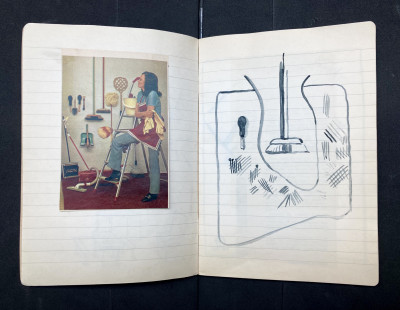
This performance of sublimation is laid bare in a series of little-known and largely unpublished lined-sketchbooks (the art historian Michael Semff has speculated that there exist several dozen sketchbooks).[3] One such sketchbook, in the Collection of German Prints and Drawings at the British Museum, archived as Untitled (sketchbook 16), c. 1969, comprises a series of twenty-eight watercolour drawings on lined-paper, seven of which are accompanied by cuttings from newspapers and illustrated magazines. This blue A5 book contains pages of rapidly executed sketches, visual ideas, chains of association, pictures cut-out and pasted from magazines and newspapers. The sketchbooks are full of bad drawings, both formally and conceptually. Polke chooses the wrong medium – i.e. watercolour – for his particular support – i.e. low gsm lined office paper –, so that the resultant line bleeds erratically, failing to cohere into something recognisable, not fitting to the prescribed matrix. Moreover, the copy and pasted images cut out from advertisements, are cropped haphazardly, denying the wholeness of their message. And when used as a model for pictorial composition, Polke’s renditions are sparse, like incomplete diagrams.