
In Madrid, the critically praised exhibition Sigmar Polke. Affinities Revealed, curated by Gloria Moure, is on view until March 16, 2025. There are various works and groups of works in Polke's oeuvre that bear witness to his encounter with Francisco de Goya's art. In photography, paintings, on paper, in books and in film, there are direct or indirect links to works by the Spaniard. The Prado exhibition provided the impetus for the text on Polke and Goya by Sophia Stang, which is printed in Spanish and English translation in the exhibition catalog and is reproduced here in German excerpts.
Polke Post 29 - On the exhibition by Polke and Goya at the Prado
POLKE POST 29
Polke and Goya at the Prado
Polke contemplates Goya
In a rare interview given in 1984, Sigmar Polke talked to Bice Curiger about the constant vibrations and changes in his work. “Layers are never forever: what is underneath cannot stay there. Layers just demonstrate a very simple trick; that everything is in motion. The head moves, too. When does the layering stop? It doesn’t! Ever! It’s interfacing with perception and inaccuracy.”[1]
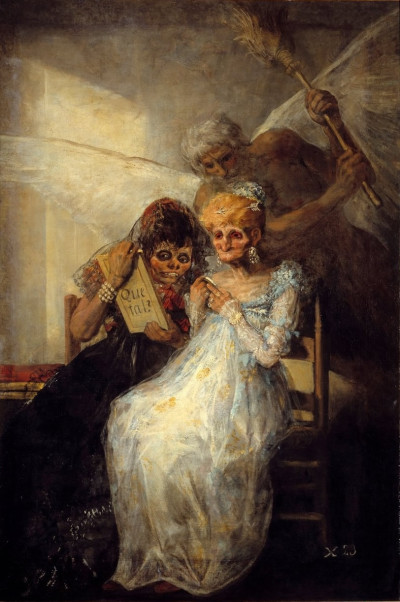
A few years earlier, in Lille, he had come face to face with Francisco de Goya’s "Las viejas" ("The Old Women"). Polke appeared to sense such vibrations in Goya’s allegorical depiction of the old ladies, in the hazy background behind the winged Chronos. In 1982, he gazed afresh at this painting and opted for a new approach, internalising it through the lens of his camera. The resulting photographs give us an idea of the veiled wraiths and spirits that Polke uncovered beneath the various layers of Goya’s painting. (…)
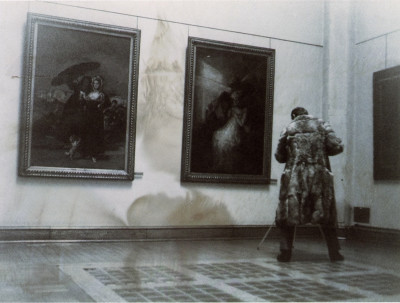
Sigmar Polke made frequent trips to France in the late 1970s and 1980s, with his then partner Britta Zoellner. They are known to have visited the Palais des Beaux-Arts in Lille in 1982: a photograph shows Polke in a fur coat, in front of "The Old Women", his camera mounted on a tripod. This was probably not his first encounter with the painting; entries in Britta Zoellner’s diaries show that they were in Lille some years earlier, in the summer of 1978, and they may have made other visits at around that time.[2] Polke’s photographic reworkings of "The Old Women" are generally dated a few years later, in 1984.[3]Even so, it was undoubtedly his close scrutiny of the original in 1982 that prompted an in-depth exploration of the painting over the next two years. We know, too, that this approach – returning to negatives exhibited before, sometimes years earlier, and subjecting them to further elaboration or processing – was very much in keeping with Polke’s working method.[4] Whatever the case, his second solo show – in April 1982 at the Bama gallery in Paris – featured one of his large-format photographs detailing the faces of Goya’s "Old Women"; indeed, it appears in shots of Polke at the vernissage.[5]
He also exhibited a number of photographic works produced during the so-called world tour, a trip lasting over a year, from which he and his partner returned in April 1981.[6] It was after the Paris opening that they visited the Palais des Beaux-Arts in Lille, where Polke and Zoellner stayed overnight on 8 April 1982.[7] The work appearing in the vernissage shots, measuring roughly 127 × 180 cm, is therefore one of Polke’s first large-format close-ups of Goya’s "Old Women", and must be based on photos taken on an earlier visit to Lille. He may also have made use of a reproduction, though this seems unlikely given the sheer size of the copy. It is one of a group of photographs, at the centre of which – unlike in Polke’s later works, which focus on the background of Goya’s painting – the two women are shown conversing; this full-length portrait, in vertical or landscape format, almost completely fills the image.[8] (…)
This early large-format photograph[9] shows a mirror image of the scene; it differs from other works in the same group in that no use is made here of double exposure or overlaid images.[10] To develop it in this format, Polke must have used photographic paper torn from a large roll, as the jagged edges suggest. This fragment of Goya’s painting has been greatly enlarged: Polke’s photograph of the detail in landscape format is almost the same size as the vertical format of Goya’s painting. At the centre of the scene, filling Polke’s image, the two wraithlike old women appear to be plotting something; mysterious waves of smoke billowing out from that focal point cover the rest of the sheet, which thus conveys a twofold effect: concentrated power, but at the same time disintegration and decay. “Polke decomposes the painting, so that a sense of decay, of evaporation, becomes unavoidable.”[11] Here, the iconographic reminder of transience, symbolised in the representation of the old women, echoes the manifestation of the material itself.
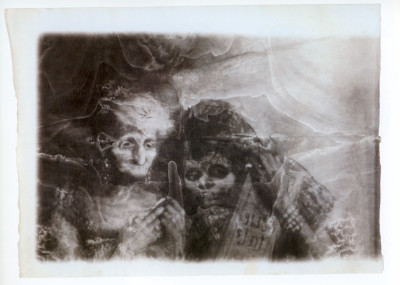
Two folds, one vertical and one horizontal, are visible in the print, intersecting in the darkness between the women’s heads. Polke developed the film himself, folding the paper before dipping it into the emulsion because it was too big for the developer bath; critics have drawn attention to this practice, a feature of his photographic work since the 1970s that testifies to his painterly handling of photographic material.[12] A veil of developer solution still seems to waft over the sheet, as though even now the process were in full swing. As Franziska Kunze has noted with regard to these materialisations in photographs by Polke shown at the German Pavilion in the 1986 Biennale: “What appears in the prints is the image-forming matter itself [...]. Ever-present yet invisible, the silver gelatin layer, the developer and fixer solutions, shape every photographic image without forcing themselves into the foreground.”[13] According to Kunze, the artist thus has a dual role: “on one hand, as the medium who conjures up spirits, on the other, as the photographer capable of bringing into the sphere of general visibility things that appear visible only to him.”[14] Throughout his career as an artist, Polke has taken a variety of approaches to spirit photography, spiritualist and occult phenomena, and magic in its many forms. In terms of his treatment of Goya’s "The Old Women", it was his role of spirit summoner, calling forth hidden images from an invisible realm, that was to emerge unmistakeably in subsequent works. (...)
Based on Polke's caressing of Goya's “Las Viejas” with the Camera, the dismantling and artistic extraction of the pictorial worlds inherent in the work, the text following this excerpt describes the characteristic role of mechanical instances such as camera and copier and the medial entanglement in the artistic creation process. See: Sophia Stang, ““You have to look fast.” Polke contemplates Goya. The fleeting materialisation of interference”, in: Sigmar Polke. Afinidades desveladas. Gloria Moure (ed.), Madrid, Museo del Prado, 2024 (pp. 29 - 38, Spanish and 181-186, English).
[1] Polke [1985] 1990, p. 25.
[2] Britta Zoellner, pocket diary, 1978, entry for 3 August 1978: “Lille”, Anna Polke-Stiftung Archive, Cologne.
[3] For example, in the catalogues for Polke’s solo photographic exhibitions: Poetter 1990 and Ferguson 1995.
[4] See Curiger 2023.
[5] The photos of the vernissage, held on 1 April 1982, were taken by Thomas Haus. Copies can be found in the Anna Polke-Stiftung Archive, Cologne.
[6] Britta Zoellner’s record of the trip, Anna Polke-Stiftung Archive, Cologne.
[7] Britta Zoellner’s diary places them in Lille on 8 and 9 April 1982, Anna Polke-Stiftung Archive, Cologne.
[8] Ten of these large-format photographs were published; see Moure [2005] 2014, p. 24.
[9] Fig, in Moure [2005] 2014, p. 174.
[10] It has been suggested that the photograph may have been taken with the aid of a mirror (Moure [2005] 2014, p. 178). Given his skilled handling of photographic material, he is more likely to have developed the negative upside down.
[11] Garrels 1992, p. 26.
[12] The folds are not found in the other photographs in this group, suggesting that they may have been developed later, in a professional laboratory. By contrast, the preparations for the show at the Bama gallery were probably carried out at very short notice: “back and forth, photo paper, - 5 hours developing”, according to Britta Zoellner’s diary entry for 29 March 1982, Anna Polke-Stiftung Archive, Cologne.
[13] Kunze 2023, p. 164.
[14] Ibid.