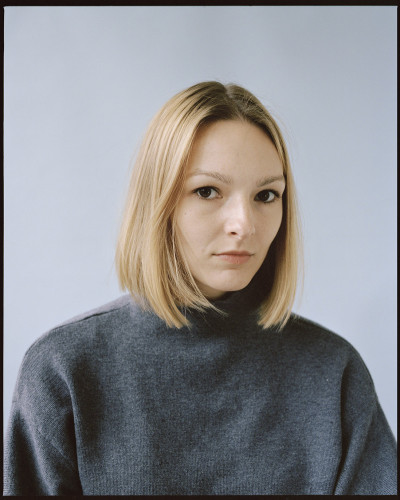
With an artistic practice situated at the margins of photography, Joanna Nencek prefers to work without a camera. Born in Krakow, she has lived in Germany since the age of fourteen and initially worked in the social sector. She studied photography and time-based media at the Folkwang University of the Arts in Essen, where she is currently completing her master’s degree in the Photography Studies and Practice program. Her work has been exhibited in group exhibitions at institutions including the Museum Folkwang, Essen; the Kunstpalast, Düsseldorf; and the North Rhine-Westphalian Academy of Sciences, Humanities and the Arts, Düsseldorf.
Scholarship 2024 - Joanna Nencek, Unfolding the photographic echo in images and objects
Joanna Nencek, Unfolding the photographic echo in images and objects
I still remember my first encounters with Sigmar Polke’s works. It was easy to connect with them because they reflected the artist’s humor and our shared interest in rendering our handling of the material visible. These aspects will also play a greater role in my own artistic work in the future. The scholarship from the Anna Polke Foundation enables me to give experimentation and chance—which are vital to this kind of work—the space they deserve.
Like Sigmar Polke, I represent an expanded understanding of photography as a medium. My primary focus is on the inextricable interplay between recognition and abstraction in images and objects. Using various digital and analog processes, I transform two-dimensional images into spatial constructions. My motifs are based on abandoned and useless objects: I am interested in anything from discarded bowls, candlesticks, cookie jars, and containers of all kinds to windows, doors, and glass shower panes, mostly of a decorative nature.
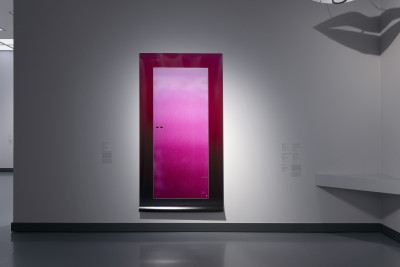
My first step is to appropriate these everyday objects—found online in the “Free” section of a classified advertisements website—in the form of screenshots of their accompanying photographs. These images, usually taken quickly on a smartphone, are converted into negatives and then printed onto paper or fabric using cyanotype, an analog monochrome printing process. In order to achieve the desired degree of abstraction, I then make interventions such as manipulating the negatives or tinting the image carrier. The next step in my treatment of these advertised objects is to actually go and collect them from the people offering them and to make photograms of them. The last thing I created using this method were some large-format color photograms of glass doors.
With this scholarship, I would like to continue to develop my approach of combining photography and sculpture in my work. Collecting large quantities of waste photographic paper from the photo lab at my university has allowed me to experiment extensively with the stability of this material. This has resulted in 80 cm long rolls of photo paper with a diameter of 2.5 cm becoming the basic components of my sculptural constructions. With the help of various pipe connectors, I assemble these rolls into scaffold-like structures resembling shelves or cupboards. The surface of the rolls demonstrates that they were once light-sensitive, now fully developed photographic paper—color gradients produced in the darkroom, analog grain, and white spots caused by dust on the negatives are all clear markers that the material is of photographic origin.
A tension emerges between the defamiliarized reproduction of the objects and the familiar
look and feel of their form, material, and dimensions. These industrially manufactured mass products, the starting point of my work, become handmade unique pieces—a status that reflects the original nature of these items. The results of this artistic project will form the basis of my graduation project and will be presented in an exhibition next year.