
For the POLKE SALON 8, art historian Nelly Gawellek talked with the restorer Michael Trier, who has been involved with Sigmar Polke and his work for many years. Their conversation focusses on Polke’s unconventional use of materials and techniques while also providing a personal insight into Michel Trier’s collaborations with the artist as well as his own career.
The following is an excerpt from the interview:
Polke Post 21 - “Against the Grain and Done Without Fear” – Excerpt from a conversation between Nelly Gawellek and Michael Trier
POLKE POST 21
“Against the Grain and Done Without Fear”
NELLY GAWELLEK: the Negativwerte (Negative Values [1982]) series heralds a period in which Polke employed a wide range of materials in his paintings. I’d like to briefly provide a few material and technical details to give an impression. For the painting Goldklumpen (Gold Nugget) also from around the same time (1982), Polke used realgar, orpiment, and Schweinfurt green on canvas. For Hochstand (Watchtower) from 1985 silver, silver nitrate, silver iodide, cobalt II chloride, and synthetic resin on canvas. For The Spirits that Lend Strength Are Invisible I (1988) meteorite granules and resin on canvas. And for the Achsenzeit (Axial Age) cycle (2005 – 2007) purple pigment – breathed, blown, wiped and polished on synthetic varnish. How did he come up with such materials and where did he get them from?
MICHAEL TRIER: He obtained the materials from a wide variety of sources. On the one hand, there was the Wolkenaer paint shop in Cologne, which sold painters’ and decorators’ supplies. A lot came from there, including the varnishes. The pigments, such as orpiment and realgar – which are ones containing arsenic – were available from Kremer Pigmente, a paint mill that still exists and is now the global market leader for pigments. I think Georg Kremer started out in the late 1970s and supplied a lot to artists, including historical paints, some of which were used in Middle Age book illumination. He was remanufacturing them and that interested Polke. There were also other things, such as meteorite dust, and all the silver compounds, which came more from the field of photography. But there were also various other substances, like cobalt chloride, indicators used in industry, such as litmus paper – materials that are able to visualize certain processes. He used all of that. All of it challenging theory, going against the grain and done without fear.
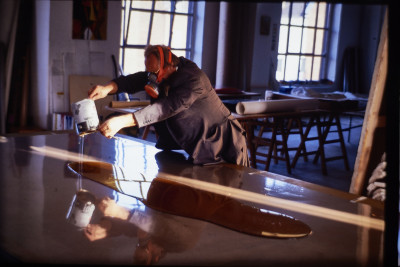
NELLY GAWELLEK: How did he come up with such an approach?
MICHAEL TRIER: I’d say curiosity and an open way of looking at things – continually looking and experimenting. Polke also produced all the so-called Farbproben (Color Experiments), the small-scale experimental paintings where everything was meticulously explored: How were the chemicals interacting? What effects could be achieved? Which ones were repelling each other? What was working, and how? What did it look like after some time?
NELLY GAWELLEK: As you’ve just mentioned, some of these substances are toxic and so, of course, are always the subject of eager discussion. What are your thoughts on that? What role did that play for him?
MICHAEL TRIER: I’d think that the toxicity was definitely something attractive. At that time, in German Gift (poison) was also a synonym for some drugs and had something hallucinatory about it. Well, Polke had orpiment, realgar, and Schweinfurt green, substances that contain arsenic and are dangerous. Then he did the uranium photographs, which is something that is initially rather frightening when you hear about it. But there aren’t that many works that he ended up painting with realgar, orpiment, and Schweinfurt green. It’s actually a relatively limited group from the early to mid 1980s and after that the only real poison involved was the solvent.

NELLY GAWELLEK: So maybe it was not so much about poison or the fact that a substance was toxic, but about the effect?
MICHAEL TRIER: It was about the effect. It was the color – Schweinfurt green, for example, is a very special, wonderful green. I don’t know exactly since when, but the sale of that green has been banned since the early 20th century. […]
NELLY GAWELLEK: What did you particularly like about Polke's work and what were the highlights of your work together?
MICHAEL TRIER: Well, there are paintings that I have continued to appreciate greatly over the decades. I think his work just doesn’t get any weaker, you can see that in the ongoing interest. Many generations of artists have repeatedly adopted him as a shining example. That’s one of his qualities.
[…]
The interview has been abridged and edited for publication. The full recording is available here.