We are very pleased that Verena Hein, curator at Kunstforum Ostdeutsche Galerie Regensburg, has agreed to be guest author of our 16th issue of POLKE POST. She curated the exhibition Sigmar Polke. Dualism, which is on view until June 19 at its second venue, the Städtische Galerie Karlsruhe, which has been organized by Stefanie Patruno. In the following text, Verena Hein reports on perceptual experiences and encounters in front of Sigmar Polke’s works, focusing particularly on younger visitors. In their unmediated way of seeing and approaching art, youthful viewers direct our attention to some of the central characteristics of Polke’s oeuvre.
Polke Post 16 - “Ways of Seeing” – a look back at the exhibition Dualism in Regensburg by curator Verena Hein
POLKE POST 16
“Ways of Seeing” – a look back at the exhibition Dualism in Regensburg
“Darth Vader of course!”
is how students in the 6th grade of a secondary school in Regensburg answered when I asked them what they could see in the limited edition print Untitled (Spiegelung I). Sigmar Polke published the photographic image in 1992 in collaboration with his longstanding gallerist Erhard Klein. And yes, I was also able to discover the mask of the legendary character from Star Wars and inevitably had to smile about such a way of reading or seeing the image. Erhard Klein reported that Polke photographed a reflection in water, enlarging it to a point where the artist’s characteristic grid of halftone dots became apparent, and then rotated it by 90 degrees. The rotation made the motifs look like Rorschach tests or X-rays – such were my own associations, which I had thought the group of students would share. Martin Kippenberger also took a liking to the limited editions, conceiving Ei-weiss Passepartout (1993) for one of the copies of Spiegelung II. It was a pleasure to observe Polke’s proposal of unbiased viewing being accepted by visitors to the exhibition.

We have assembled around 100 works for the exhibition Sigmar Polke. Dualism that are being presented using binary terms. The concept follows the principle in Polke’s oeuvre of a “state of being dual or consisting of two parts; division into two.”[1] The work explores fundamental principles that either complement or contradict each other. This does not involve clearly defined polarities, but rather concerns an overcoming of opposites. In 1966 the artist stated it in terms of being “happy that I don’t only see black and white but both at once.”[2] And his close friend and curator Bice Curiger likewise remarked: “Polke boils down contradictions, obsolete vocational dualisms, (human) gender and history, letting them evaporate until all that is left of their energy is an enchanted surface layer of mist.’”[3]
Such energy would seem to persist in Polke’s work without really aging, in a play between Wahrnehmung und Magie (The Perceptual and The Magical). In addition to the works already mentioned above, the likewise titled section also presented the large-format Himmelsbilder (2006) series of photographs. If some viewers believe they can recognize figurative motifs or faces in the cloud formations, then this is due to a phenomenon called pareidolia as defined by perceptual psychology. Polke employs it in some of his works, exploring vision and our perceptual and imaginative powers as if in a transcendent approach. A way of seeing that expands our consciousness was fundamental to the artist.
Parapsychological experiments attracted his interest as becomes apparent in the outstanding Tischerücken from 1981, for example, as do neurological structures, which are evident in the painting Schrott (1994). The use of shimmering interference pigments evokes 3D models of neural pathways. Yet Polke was already addressing such matters in his so-called Rasterbilder during the1960s. He particularly liked “the way that the dots in an enlarged image begin to blur and move about. The way the motif changes from being recognizable to unrecognizable, the unresolved, the ambiguity of the situation, and it remaining open.”[4] I experienced this “remaining open” and the impossibility of deciphering the motif in conversations with visitors in front of Menschenmenge (1966). Personal memories, preferences, or the range of experience the respective age group possesses filter or even precipitate interpretations.
A knowledge of visual memory, whether individual or collective, is discernible in Polke’s artistic approach that conveys timelessness. Because these images, formed in the past, were not fixed by the halftone pattern, they remain open and permeable in both structure and essence.
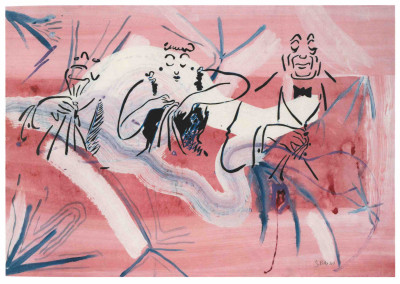
The ambiguities of visual uncertainty can also be found in the relationship between the image support and image, and in the use of differing pictorial media.[5] Polke employed a range of materials that themselves conveyed content, such as printed decorative fabrics. Ambiguity stretches like a net over his entire oeuvre. It is a game involving an incredible knowledge of art and contemporary history, literature, artistic techniques, and much more, and an approach that provides the work of art with space to complete itself – it invites a dialogue with viewers. A final anecdote from the school class: one pupil was able to identify the broad white brushstroke reaching the noses of the silhouetted figures in the paper work
Serviettengebrauch (1981) as the smell of the food. That Polke addresses a further sense in the form of a physiological perception is another instance in which his humor becomes apparent. This surprising moment in Polke’s work that is frequently referred to as ironic could perhaps be paraphrased using the concept of satori in Zen Buddhism, which is comparable to laughter, but actually represents a sudden awakening that endows perceptions with clarity.
Verena Hein
[1] “Dualism,” cited from Collins, https://www.collinsdictionary.com/dictionary/english/dualism (accessed on: May 19, 2022).
The exhibition was on view from Oct. 9, 2021 to Jan. 16, 2022 at Kunstforum Ostdeutsche Galerie in Regensburg and subsequently at the Städtische Galerie Karlsruhe from March 5 to June 12, 2022 (extended until June 19, 2022).
[2] Sigmar Polke, in: Dieter Hülsmann, “Kultur des Rasters. Ateliergespräch mit dem Maler Sigmar Polke,” in: Rheinische Post, No. 108, May 10, 1966.
[3] Bice Curiger used the term dualism in the exhibition she curated in 2005 Works & Days. Cf. id., “Works & Days: ‘If you can’t figure it out, you’ll have to swing the pendulum yourself,’” in: Sigmar Polke. Works & Days (exhib. cat. Kunsthaus Zürich), Cologne 2005, pp. 8–27, p. 11.
[4] Polke (1966), see note 2.
[5] For this cf.: Verena Krieger, “‘At war with the obvious’ – Kulturen der Ambiguität. Historische, psychologische und ästhetische Dimensionen des Mehrdeutigen,” in: id. and Rachel Mader (eds.), Ambiguität in der Kunst. Typen und Funktionen eines ästhetischen Paradigmas, Weimar/Vienna 2010, pp. 13–49.