
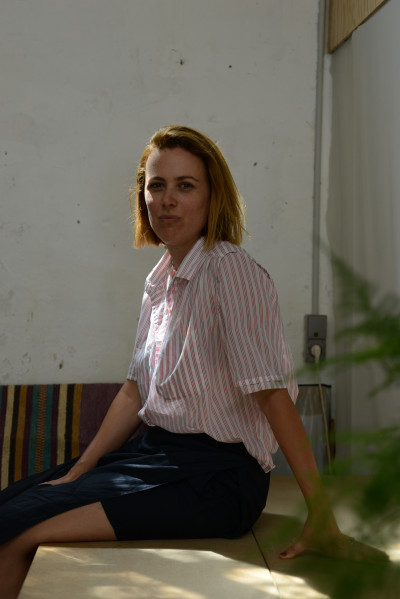
Violaine Barrois (b. 1984) is a visual artist working at the intersection of ecology, material history, and collaborative research. She extracts shell-fish purple from Rapana venosa, an invasive gastropod in the Étang de Berre, reactivating ancient Mediterranean dyeing traditions. A 2026 Villa Albertine resident, her work has been shown internationally. She lives and works near Aix-en-Provence.
Scholarship 2026 - Violaine Barrois Invasive Purple
Violaine Barrois, Invasive Purple. Pigment and Material Futures of Rapana venosa
Throughout his career, Sigmar Polke explored the transformative potential of materials, pigments, and chemical processes. Invasive Purple proposes to revisit Athanor through the lens of material transformation and pigment history, focusing on a specific case study: the reactivation of shellfish purple — the ancient Mediterranean dye historically extracted from murex sea snails — using Rapana venosa, an invasive gastropod recently introduced into the Étang de Berre, a Mediterranean lagoon near Marseille profoundly shaped by petrochemical industry and maritime circulation.
Shellfish purple is one of the most emblematic pigments of the ancient Mediterranean world. Ist production relied on a complex sequence of fermentation, enzymatic reactions, light exposure, and oxidation — a labor-intensive process that made the color both rare and politically charged, closely associated with imperial power across more than a millennium of coastal workshops.
Archaeological evidence attests to its production in Toulon between the 1st century BCE and the 5th century CE. Today, Rapana venosa — native to the seas of the Far East, introduced to Europe through ballast water — has established itself in the same lagoon where these traditions once circulated. Its hypobranchial gland produces tyrindoxyl sulfate, the same biochemical precursor the Phoenicians extracted from Hexaplex trunculus. The molecule is identical. The animal is not. The project emerged from three years of research-action around the Étang de Berre, developed in collaboration with Guillaume Marchessaux (IMO – Aix-Marseille Université, CNRS, IRD) and building on the teaching of Inge Boesken Kanold, specialist in rare and lost historical colors. A full extraction protocol has been developed and tested: hypobranchial gland dissection, photochemical activation, fermentation-based vat reduction, and solid pigment production. The dye vat recipe, considered largely lost, has been successfully reconstituted. This research will be presented in Paris in October 2026 alongside Tom Sidaine (AMU, CNRS) at the colloquium Penser au bord du monde, under the title Couleur locale: Rapana venosa: interpréter pour intégrer.
Rather than treating pigment simply as color, this project approaches material as an active agent: unstable, time-dependent, ecologically situated. The transformation from colorless secretion to deep purple unfolds in minutes under sunlight — a process that cannot be fully controlled, only attended to. This instability is not a limitation but the core of the practice. It is here that the project finds its strongest resonance with Polke's Athanor: both practices engage with matter as something that transforms, reacts, and escapes complete mastery. Polke's interest in forbidden pigments, toxic substances, and alchemical processes was not metaphorical — his materials interact unpredictably, surfaces change over time, substances generate effects that exceed intention. Invasive Purple inherits this disposition and grounds it in ecology. His exploration of image distortion, altered states, and dangerous materials finds a direct parallel in the instability and biological charge of shellfish purple — a secretion that burns, stains, and smells of sulfur before it becomes color.
By extracting an ancient color from an invasive body, the project interrogates dominant ecological narratives. Rather than opposing a supposedly pure nature to exogenousdisturbance, it treats Rapana venosa as a material witness to the global circulations of goods, ballast water, and industrial infrastructure that define the Anthropocene. The invasive species becomes a revealer — not a problem to be erased, but a symptom to be read, handled, and transformed into pigment. Placing this research in dialogue with Athanor allows us to see Polke's work as part of a longer history of artistic engagement with transformative substances, connecting his material experimentations to contemporary pigment research where chemistry, ecology, and cultural inheritance are no longer separable.