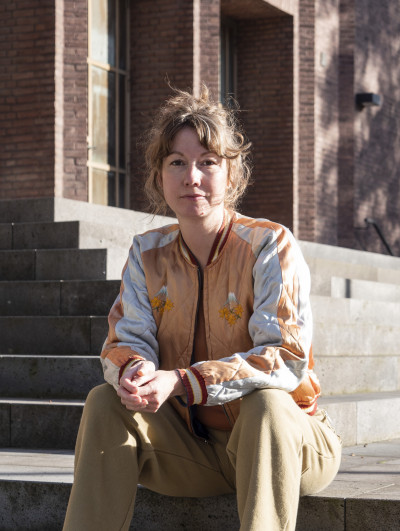
The artist Nico Joana Weber uses artistic research methods to explore processes of transformation and appropriation, as well as the visualization of hidden narratives. She studied Fine Art and Art History at Goldsmiths College, London and completed her postgraduate studies at the Academy of Media Arts in Cologne. Weber has presented her work in numerous international exhibitions and screenings and has been awarded various prizes, including the Villa Romana Prize and the Bonn Art Prize, as well as scholarships and residencies.
Scholarship 2025 - Nico Joana Weber, Dirk, any ideas?
Nico Joana Weber, Dirk, any ideas?
As part of the scholarship, I plan to conduct comprehensive research into the productive (working) relationship between Sigmar Polke and my father Dirk Weber, who supplied Polke with painting materials and adviced him for decades. The aim is to create a collection of materials that will include photographs, documents, material samples, and notes from conversations.
Dirk Weber was born in Sendenhorst in 1947 and moved to Bonn in 1970, where he launched his company, Dirk Weber Feines Künstlermaterial, in 1979. From the very beginning, his goal has been to provide professional artists with high-quality products sourced from all over the world after years of exhaustive research, or even to produce them himself where necessary. Close communication, personalized consultation and services as well as site-specific work and solutions complete Dirk Weber’s portfolio and make his approach truly unique. Many artists trust his knowledge and precise work and keep coming back to him. Although Weber is approaching eighty, he has no intention of calling it a day—the demand for his work and his investment in his work is too great.
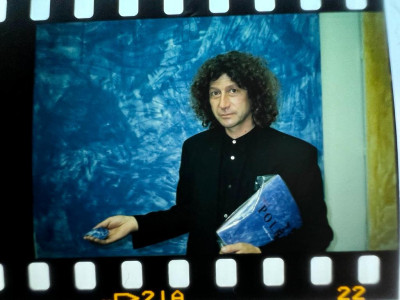
Dirk Weber met Sigmar Polke in 1981. It was the beginning of an intense relationship and friendship. Polke gifted Weber paintings he had dedicated to him, celebrated with him at openings, and immersed himself in the (Rhineland) art scene of the 1980s. Over the years, Weber advised Polke about materials and visited him regularly in his studio. “Dirk, any ideas?” was a question often put to him, which always prompted Weber to look out for new, interesting materials for Polke, in turn inspiring his works. He supplied him with the interference colors used in the Magische Quadrate (Magical Squares) cycle, special synthetic pigments used to color the lacquers in the Laterna Magica series, for example, and canvases that were specially designed and produced for the Athanor exhibition in Venice. Weber also supports Polke with his expertise in working with natural pigments and minerals. He procured high-quality malachite and azurite pigments for the artist, and Sigmar Polke inspired him to produce lapis lazuli pigment of an unprecedented quality, which Polke then used in the 1992 exhibition at the Stedelijk Museum, for instance. The four-part image cycle Zinnober (Cinnabar, 2005) was also based on cinnabar pigment found by Dirk Weber in Beijing; it was of such exceptional intensity that Weber himself says he has never been able to obtain anything like it again since, and it was this distinctive quality that inspired Sigmar Polke to create his paintings.
The aim of my project is to investigate these and other details relating to the materials and production aspects of Sigmar Polke’s work and to make them available to the Anna Polke Foundation archive so that they are accessible for future research. The resulting material collection links back to Sigmar Polke’s Venice exhibition and the related materialities highlighted by the research and education project Sigmar Polke: Athanor NOW. At the same time, it also sheds light on an important work that takes place in the background and influences as well as inspires artistic production. Art is not created in a vacuum; it thrives on diverse stimul, and I plan to trace this process in the long-standing collaboration between Sigmar Polke and Dirk Weber.